At the EGU General Assembly 2026 in Vienna, three contributions from our group addressed past Human–Earth system dynamics from complementary perspectives.
The studies were developed under the scientific guidance of Yaping Shao and combine palaeoclimate data, vegetation modelling, archaeological questions, and machine-learning approaches.
Philipp Schlüter presented “Learning the Green Wave”, a hybrid machine-learning framework for reconstructing past vegetation seasonality from modern satellite observations and bioclimatic
predictors.
Guohao Liang’s contribution focused on climate-based Human Existence Potential and possible dispersal pathways of Homo sapiens into East Asia between 80 and 30 ka.
Christian Wegener applied the Human Existence Potential model to European occupation and settlement patterns, spanning early hunter-gatherer presence and the emergence of farming societies.
Taken together, the three contributions show how shared modelling concepts can be adapted to different questions: vegetation dynamics, human dispersal, and long-term settlement patterns.
They also reflect the broader aim of our group to connect climate science, archaeology, and data-driven modelling in the study of past human–environment interactions.
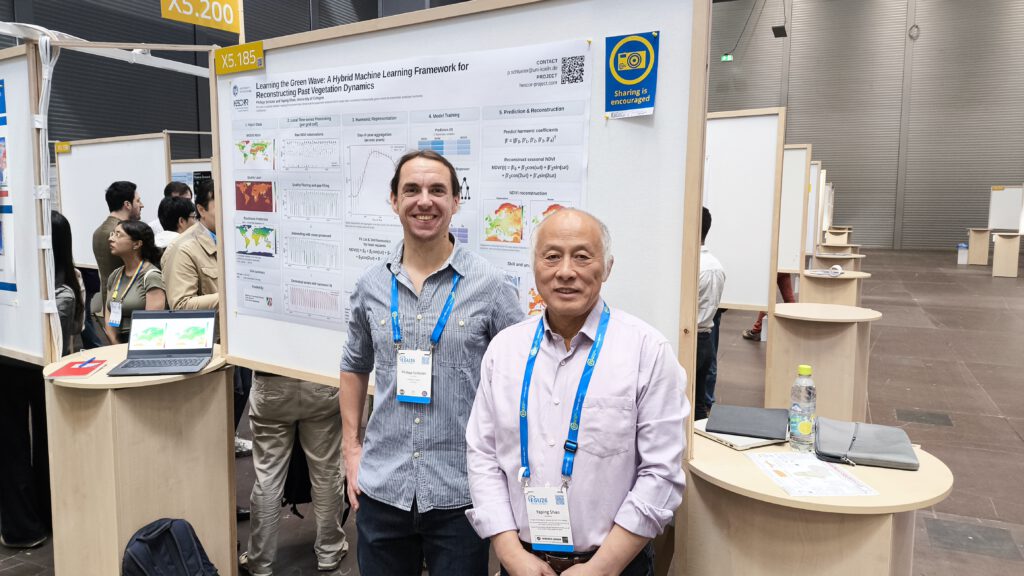
Philipp Schlüter and Yaping Shao in front of Philipps poster at EGU26
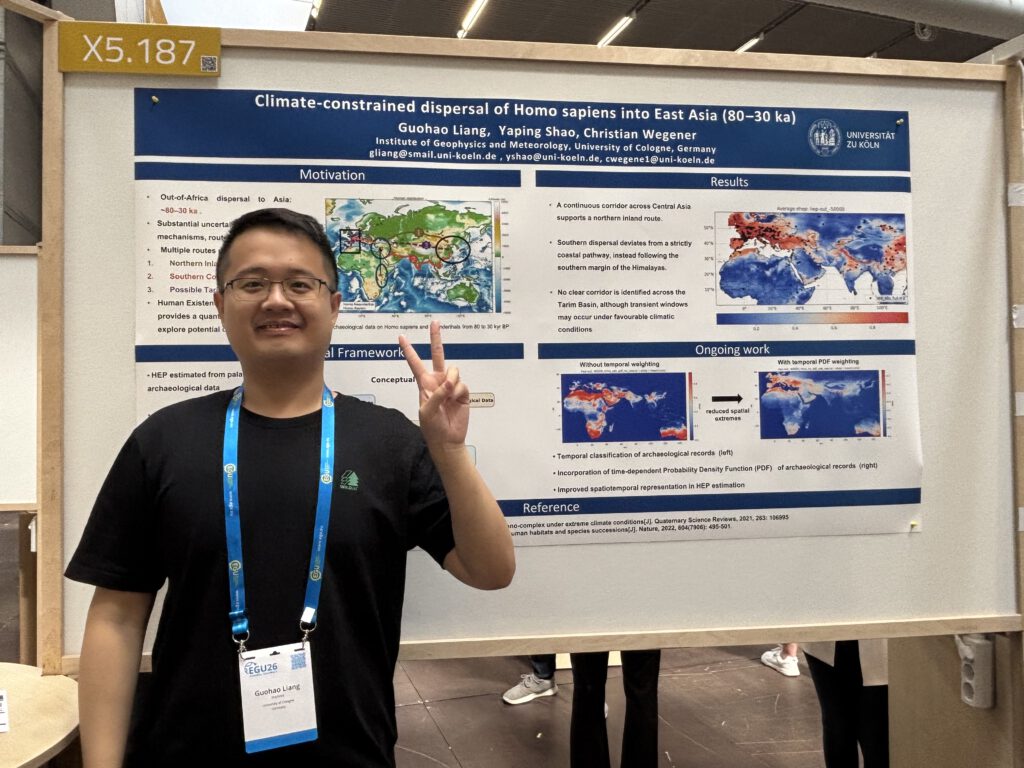
Guohao Liang and his poster at EGU 26