We often think of clothing in early human evolution as „dress“, „haute couture“ or simply as functional (protection against the cold, etc.). Dr. Shumon T. Hussain argues that this has fundamentally clouded our view for the role of clothing in negotiating past human-animal relationships.
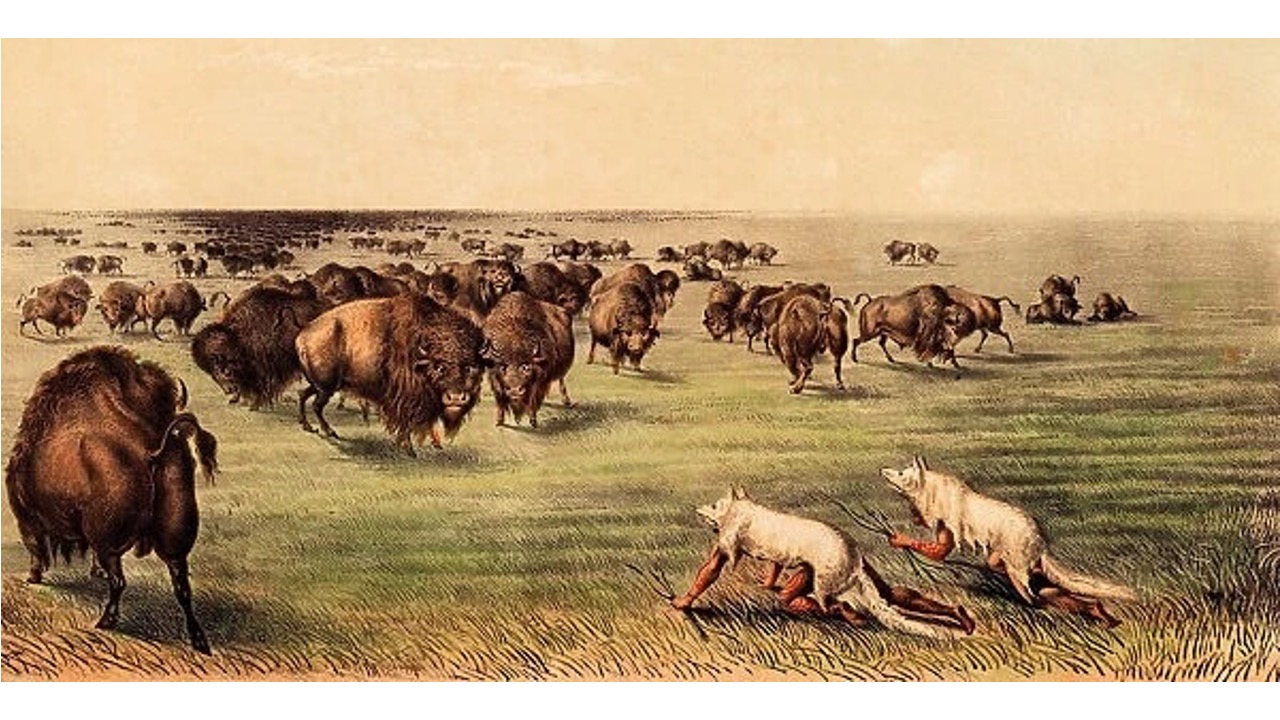
Fig.: Mary Evans, ›Native American Indian Buffalo hunt under the White Wolf Skin. An Indian stratagem on the level prairies‹ (c. 1858). Note the emphasis on ›stratagem‹ (trickery, stealth, deceit), behavioural features regularly deduced from the supposed need of the primitive to survive in open landscapes (such as the Savannah and Prairie) and hence aligning Indigenous North Americans with early hominins. Note also that in these 19th-century discourses, the prairies were cast as an ›uncivilised‹ country, unproductive and resisting the call of civilisation. Museum of the City of New York.
Hussain, S.T. (2025). Beyond dress, protection, and disguise: Re-inserting animals into the deep history of human clothing, in Jöris, Olaf et al. (Hrsg.): Zur Geschichte der Kleidung in der Steinzeit/A Stone Age History of Clothing. Heidelberg: Propylaeum (Tagungen des Landesmuseums für Vorgeschichte Halle, Band 33), 65–76. https://doi.org/10.11588/propylaeum.1678.c24334