Created: 04.03.2026

Simulating Neanderthal–modern human dynamics in Ice Age Iberia

A new open-access study in PLOS ONE presents a high-resolution simulation of population dynamics during the Middle-to-Upper Paleolithic Transition (roughly 50,000–38,000 years ago) on the Iberian Peninsula.
What the study finds

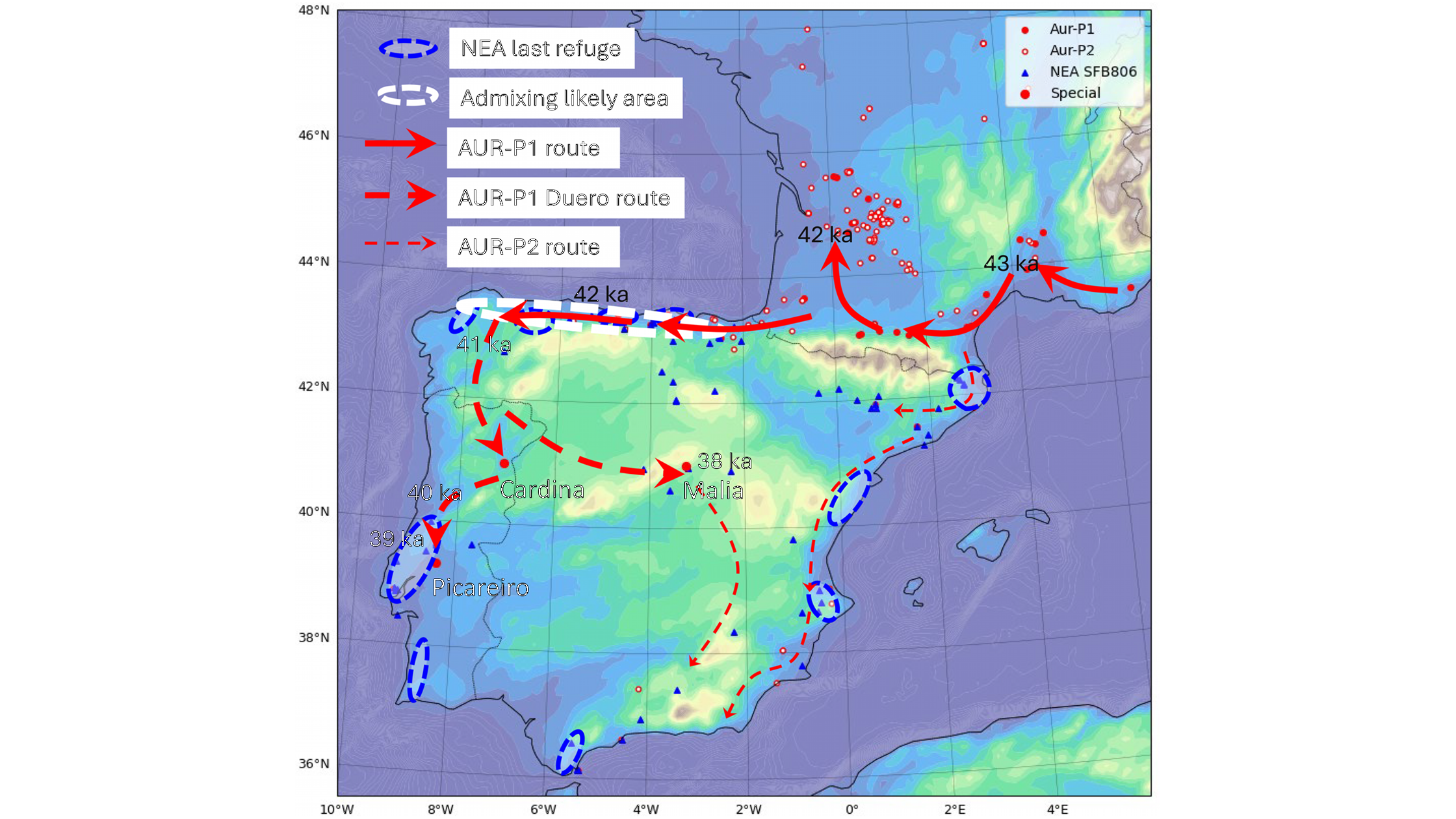
Using ensemble simulations that combine climate variability with modeled mobility and interaction networks, the study explores when and where Neanderthals (NEA) and anatomically modern humans (AMH) could have overlapped in Iberia—and what that would imply for contact and mixing.

Key results include:

  • Neanderthals largely restricted to coastal refugia in the modeled scenarios, and already in decline when AMHs arrive.
  • Heinrich Event 5 is identified as a likely accelerator of Neanderthal decline via climate stress and demographic collapse.
  • AMHs expand rapidly into Cantabria, with modeled overlap that could allow small amounts of admixture (2–6%) in the scenarios where contact occurs.
  • The model predicts additional dispersal corridors, including an Atlantic coastal route into Cantabria and inland movement via a “Duero Route” into Portugal and the central Mesetas.

The approach offers a way to dynamically test a range of plausible scenarios, complementing archaeological and genetic evidence that is often static or affected by dating uncertainties.

Open science: code and data

The article is open access and includes a public data/code repository reference..

Read the paper

DOI: 10.1371/journal.pone.0339184

CONTACT
Universität zu Köln
Weyertal 125
50931 Köln
Germany
Dr. Isabell Schmidt
Coordination
Phone: +49 221 470-3385
isabell.schmidt@uni-koeln.de
Mo.-Fr.: 9–15 Uhr
Funded by:

University of cologne