Dr. Elena Robakiewicz and her colleagues used a multi-proxy record to better understand changes at Lake Nakuru in Kenya starting about 40,000 years ago. They found that multi-proxy records are especially necessary in highly alkaline soda lakes and that Lake Nakuru’s chemistry may have changed with short-term changes in climate related to the Northern Hemisphere.
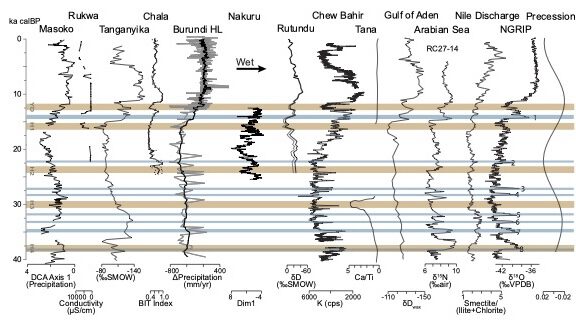
Fig. 1: Comparison of lake records from across the East African Rift System with general wetter conditions plotting to the right and Dansgaard-Oeschger events in blue and Heinrich events in brown. These records include: the precession cycle (Bergner et al., 2009), NGRIP δ18O (North Greenland Ice Core Project members, 2004), the Nile clay record (Ehrmann et al., 2016), δ15N from the Gulf of Oman (Altabet et al., 002), δD of leaf wax from the Gulf of Aden (Tierney and deMenocal, 2013), Ca/Ti of Lake Tana (Lamb et al., 2018), K of Chew Bahir (Foerster et al., 2012), δD left wax record from Lake Rutundu (Garelick et al., 2021), K/Ti and Dim1 (from PCA) ghost plots from Lake Nakuru (Robakiewicz et al., 2025), precipitation estimate from pollen record from the Burundi Highlands (Bonnefille and Challie 2000), BIT Index from Lake Chala (Verschuren et al., 2009), δD of leaf wax from Lake Tanganyika (Tierney et al., 2008), diatom conductivity transfer function from Lake Rukwa (Barker et al., 2002), and the DCA Axis 1 from Lake Masoko from (Barker et al., 2003).
Elena Robakiewicz, Andreas G.N. Bergner, Carolina Rosca, Simon Kübler, Veronika Ketzer, Martin H. Trauth, Annett Junginger,
Moisture availability and productivity at Lake Nakuru, Kenya leading into the African Humid Period, Quaternary Science Reviews, Volume 369, 2025, 109579, ISSN 0277 3791, https://doi.org/10.1016/j.quascirev.2025.109579.