Earth’s vegetation has never been static. Forests have expanded and retreated, deserts have shifted, and vegetation zones have reorganized in response to changes in climate, atmospheric CO₂, and large-scale boundary conditions such as ice sheets. Understanding these dynamics is key to reconstructing past environments and improving projections of future climate change, because vegetation not only influences climate, carbon storage, and hydrology, but also shapes the environments in which human societies live, move, and adapt.
Pollen-based reconstructions show how vegetation responded to past climate changes, making them a valuable benchmark for testing whether Earth System Models—complex computer models that simulate interactions between the atmosphere, oceans, land, ice, and biosphere—capture a changing world. In our study, we compare a new Northern Hemisphere tree cover reconstruction for the past 20,000 years (Schild et al., 2025) with a simulation from the MPI-ESM1.2 Earth System Model (Kleinen et al., 2023). At large scales, the model performs well: it captures the transition from open glacial landscapes to more forested conditions and the northward expansion of trees as the climate warmed. But at regional scales, it struggles, with clear deviations from the pollen data—exactly where detailed interpretations, for example in archaeological contexts, matter most.
These mismatches highlight a key limitation of current vegetation models: while they capture large-scale climate–vegetation interactions, they simplify or miss regional processes, limiting their reliability at local scales. The key question is therefore where these differences come from. Are they driven by incorrect vegetation sensitivities to climate and CO₂? Do they reflect biases in the simulated climate? Or do they arise from uncertainties in the reconstructions?
Our results show a clear pattern: where models and pollen data agree, vegetation responds smoothly to climate change. Where they do not, responses become more complex and non-linear, particularly with respect to summer temperatures, and the model tends to overreact to CO₂. Some mismatches trace back to climate biases, especially in temperate forest–steppe regions; others, such as in the boreal forests of Siberia, point to structural model limitations.
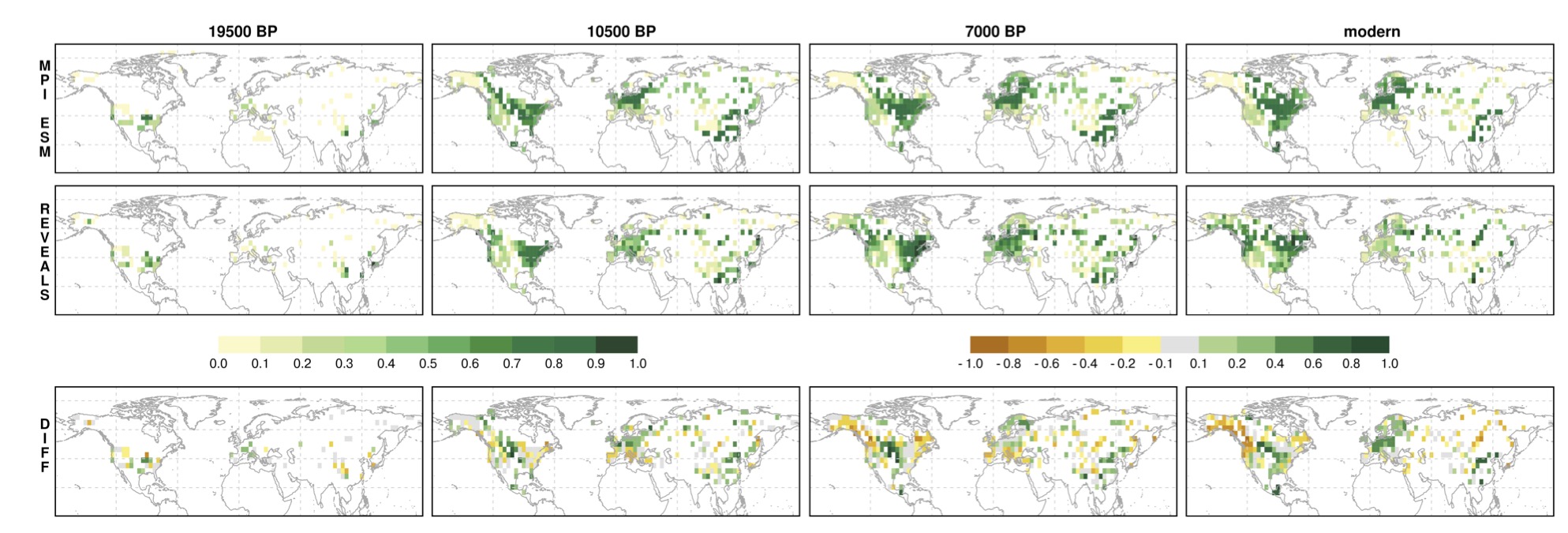
Tree cover fraction in the MPI-ESM simulation (upper row), pollen-based REVEALS reconstructions (second row) and tree cover difference between MPI-ESM and REVEALS (last row) for selected time-slices.
Ultimately, this reflects a familiar trade-off: dynamic vegetation models simplify ecosystems to capture the global picture—but this also limits their ability to represent local drivers of change. Improving them is therefore less about adding detail and more about understanding how climate and ecosystems interact across scales. It is precisely this gap that becomes visible when simulations are confronted with pollen-based reconstructions.
Do you want to learn more? Explore our new paper here.
Kleinen, T., Gromov, S., Steil, B., and Brovkin, V.: PalMod2 MPI-M MPI-ESM1-2-CR-CH4 transient-deglaciation-prescribed-glac1d-methane, https://doi.org/10.26050/WDCC/PMMXMCHTD, 2023.
Schild, L., Ewald, P., Li, C., Hébert, R., Laepple, T., and Herzschuh, U.: LegacyVegetation: Northern Hemisphere reconstruction of past plant cover and total tree cover from pollen archives of the last 14kyr, Earth System Science Data, 17, 2007–2033, https://doi.org/10.5194/essd-17-2007-2025, 2025