Around 300,000 years ago, our species—anatomically modern humans (AMH)—emerged in Africa. Fast forward to about 40,000 years ago, and we had already reached Europe. But how and why did our ancestors embark on this journey across continents and climates? That’s the focus of the “Our Way Model” (OWM), a new scientific approach to understanding ancient human dispersal using archaeological insights, climate data, and computational modeling.
Human movement in the deep past was shaped by a complex mix of factors, much like today: ecological changes, access to resources and knowledge, social networks, and evolving technologies. The Ice Age climate added an extra challenge, alternating between cold glacial periods and warmer interglacials. To make sense of these dynamics, researchers created a tool called the Human Existence Potential (HEP). By combining archaeological site data with palaeoclimate simulations, HEP predicts which areas would have been most suitable for human life at different times. This forms the backbone of the OWM, which tracks population movements across tens of thousands of years.
So what did the model reveal? The journey of AMHs into Europe unfolded in four distinct phases—from slow beginnings in the Near East to a rapid spread across western Europe, followed by a population decline and then a resurgence. The model not only reconstructs migration patterns but also estimates population size and density. It highlights how environmental barriers or sparse populations could slow or reverse dispersal. As part of a broader research initiative, HESCOR, the model is being expanded to include more aspects of the relationship between humans and their environments. This opens the door to deeper insights into how climate, landscape, and human decisions shaped our species‘ past—and perhaps our future.
In German: https://portal.uni-koeln.de/universitaet/aktuell/meldungen/meldungen-detail/neues-populationsmodell-definiert-vier-phasen-der-menschlichen-besiedlung-europas
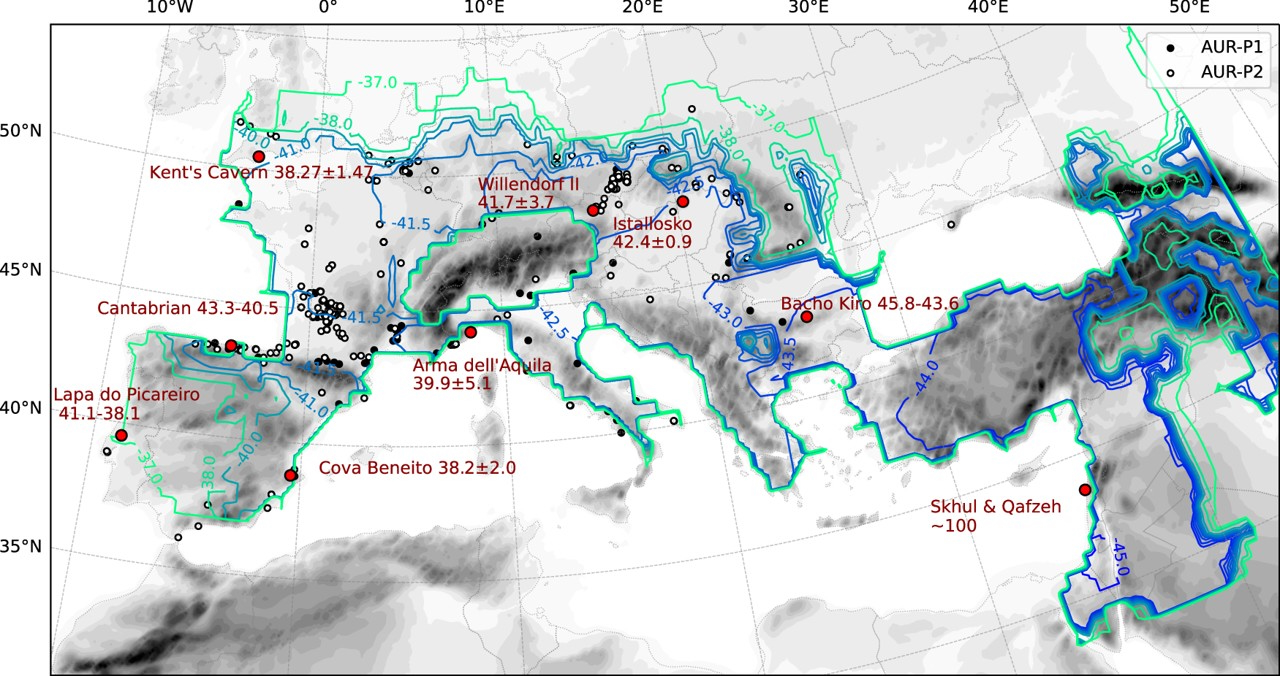
Fig.: Contours of the arrival time of human expansion in ka, defined by population density reaching 0.4 P 100 km-2 for the first time.
Please note that ChatGPT (OpenAI, May 2025, https://chat.openai.com) was used to refine parts of the text, which was subsequently edited by the author for structure, style, and content.