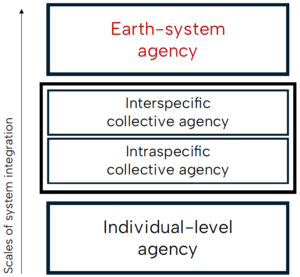
Taking seriously the idea of the anthroposphere discussed in the previous post demands that we rethink the crucial issue of human agency in the Earth system. At its most basic, “agency” denotes the capacity to act and bring about effects in the world, but its precise meaning, scope, and attribution are subject to ongoing interdisciplinary discussion. In dominant traditions of European thought, agency has not only commonly been attributed to humans alone (and not even to all humans equally) but also tied to a particular understanding of human beings as autonomous, rational individuals who initiate action based on deliberate intentions. This tenacious notion of agency has made it difficult to recognize the extent to which human action is enabled, constrained, and co-shaped by forces that exceed it: social structures and institutions, technical systems, nonhuman beings and ecosystems, and broader Earth-system dynamics.
It is now often claimed that humans have become a “planetary force,” as if humanity as a whole were a single unified agent intentionally steering the fate of Earth. We propose that Earth System Science (ESS), especially a version that takes insights from the humanities seriously, suggests a more complex picture that no longer assumes that human agency and collective decision-making are simply an aggregate property of individuals. What is needed, instead, is a multi-level approach that recognizes that different components within the anthroposphere – perhaps even the anthroposphere itself – may develop different forms of agency, and that these forms of agency mediate each other through feedbacks. The technosphere, specifically the question of its relative autonomy, may serve as an example in that it is now increasingly conceptualized as a global system operating beyond individual and collective agency in any straightforward sense, one whose internal dynamics and path dependencies condition what kinds of choices humans and institutions can practically make.
Many outcomes, including such large-scale developments as human-driven mass extinctions or the spread of microplastics, have not been “consciously” chosen but rather emerge from complex interactions across different levels of the anthroposphere. Such outcomes are not only the result of human actions but of patterned interactions among multiple species (including domesticated animals, crops, commensals, and pathogens) that together shape Earth system trajectories. What is commonly framed as human collective action thus often involves a distinctly “more-than-human” or interspecific dimension. Attending to the role of interspecific collective agency shifts our focus from an overly reductive idea of human decision-making to the heterogeneous assemblages of humans and nonhumans whose combined activities drive planetary change.
The anthroposphere can therefore be seen as an overarching structure that shapes, constrains, and sometimes amplifies human agency. Individual and even collective decision-making, including its failures and inefficacies, are a problem to be explained rather than something taken for granted as the obvious driver of historical change. ESS must accommodate and distinguish between different levels of agency – individual, societal, regional and transregional, and planetary (or anthropospheric) – and the models we produce must take into account the nonlinear, historical, and interactional dynamics between them, including learning or adaptation. This also means paying closer attention to what has been referred to as social tipping points or dynamics – situations in which even comparatively small social changes can trigger larger and often rapid shifts in behavior or institutions. Understanding the anthroposphere as a historically evolving sphere with shifting degrees of autonomy is essential if we want to grasp how humans and their distributed, multi-level forms of agency are increasingly woven into the fate of the planet.