Earth System Science (ESS) studies the complex interactions between Earth’s sub-systems or “spheres,” including that of living beings and ecosystems (biosphere). An issue that has become increasingly prominent in the development of ESS is how to adequately represent the role of human impacts and activities. One result of this has been the proposal to consider the specific role and evolution of the “anthroposphere” (from anthropos, Greek for “human”). Yet how humans interact with the Earth is highly complex, and the anthroposphere itself is neither a homogeneous nor a static entity. To grasp more precisely what is at stake in this proposal, we can unpack the anthroposphere into several distinct but interrelated components and further identify a number of cross-cutting dynamics that help us make sense of its functioning.
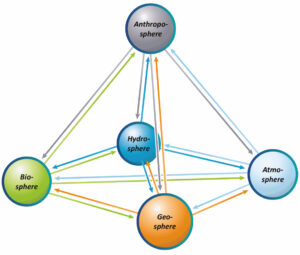
Conceptualizing the Earth System as governed by mutual interdependencies of its spheres. Source: German National Academy of Sciences Leopoldina (2022): Report on Tomorrow’s Science. Earth System Science – Discovery, Diagnosis, and Solutions in Times of Global Change, p. 11.
First, we can think of the anthroposphere as itself made up of several “subspheres.” The sociosphere brings into focus the activities and interactions of humans as social beings, including the organization of human populations, the formation of social norms and institutions, social learning, and exchange (economy). Importantly, all of this typically involves nonhumans – animals, plants, and even landscape features – that are sometimes integrated in human social life in different roles and functions. The technosphere brings into focus humans as technological beings, specifically the structure and organization of largely or fully human-made technological worlds, including material and virtual infrastructures and technical artefacts and systems such as the communication, transportation, and energy networks within which humans live and act. Finally, the noosphere (from noos, Greek for “mind”) and semiosphere are concerned with humans as reflective and meaning-making beings who co-produce and make sense of the sign worlds they inhabit – from explicitly articulated bodies of human knowledge (noosphere) to the wider webs of signs and signals shared among humans and sometimes between humans and other organisms (semiosphere). While these two spheres are analytically distinct, in practice they are deeply intertwined. For example, climate science as a specialized body of knowledge with associated models, scenarios, and concepts belongs to the noosphere, but the circulation of these through media, education, and politics, also makes them a part of the semiosphere, shaping how people perceive, value, and act in relation to changing climates. Humans develop and curate different systems of knowledge and values that inform and legitimize human actions and institutions. Crucially, instead of thinking about knowledge as a purely positive force (for example, in terms of “progress”), we need to look critically at how different forms of knowledge are bound up with structures of power, and how this shapes their effects on both human and nonhuman lives.
Second, we may consider key dynamics that shape the functioning and evolution of the anthroposphere. Since the forms, reach, and intensity of human involvement in Earth processes are not uniform across time, historicity – the fact that these involvements are historically situated and changing – must be understood as one of its key dimensions. The anthroposphere is not stable but a historically evolving complex of social, economic, cultural, and technological arrangements that shape how humans interact with and impact other Earth systems. The much-discussed idea of the “Anthropocene” – the “age of humans” – can thus be understood as one particular Earth-system configuration in which human influence has come to shape the functioning of the planet in unprecedented ways. Related to historicity is the issue of autonomy: how should we think about the anthroposphere’s dependence on and entanglement with the other spheres? And to what extent have some of its components become relatively self-reliant? The development of the technosphere, which according to some scholars has become quasi-autonomous with its own momentum largely beyond human individual or even collective control, may be considered a striking example of this. Finally, the evolution of the anthroposphere is defined by recursivity, that is, by processes in which human systems (such as economies, political institutions, and information networks) repeatedly respond to and reshape their own previous states, developing their own internal logics and feedbacks. While the anthroposphere is therefore always open to other spheres – it depends on matter, energy, and life – its functioning is also shaped by patterns of self-organization that we need to understand in their own right, even as we seek to trace their couplings to the rest of the Earth system.