Around 10,000 years ago, one of the greatest transformations in human history began: people stopped living solely as hunters and gatherers and started to farm and raise animals. The earliest farming communities in Central Europe, known as the Linearbandkeramik culture (or LBK for short), spread across the Northern European Plains between about 5400 and 4900 BCE. They built long wooden houses, cultivated cereals, and kept cattle, pigs, and sheep/goats. In doing so, they transformed the landscapes they lived in.
As part of the HESCOR project, researchers from the University of Cologne are studying how the natural environment influenced settlement choices. Archaeologists, meteorologists, and palynologists work together to explore how climate, soil quality, and landscape affected where people decided to live and how they spread into new regions.
To address these questions, the team uses a model called Human Existence Probability (HEP). Originally developed to study hunter-gatherer societies, this model has been adapted for early farming communities. By combining archaeological data with climate reconstructions and soil maps, the researchers can identify which areas offered the best potential for early agriculture, and how people’s movements were shaped by those conditions.
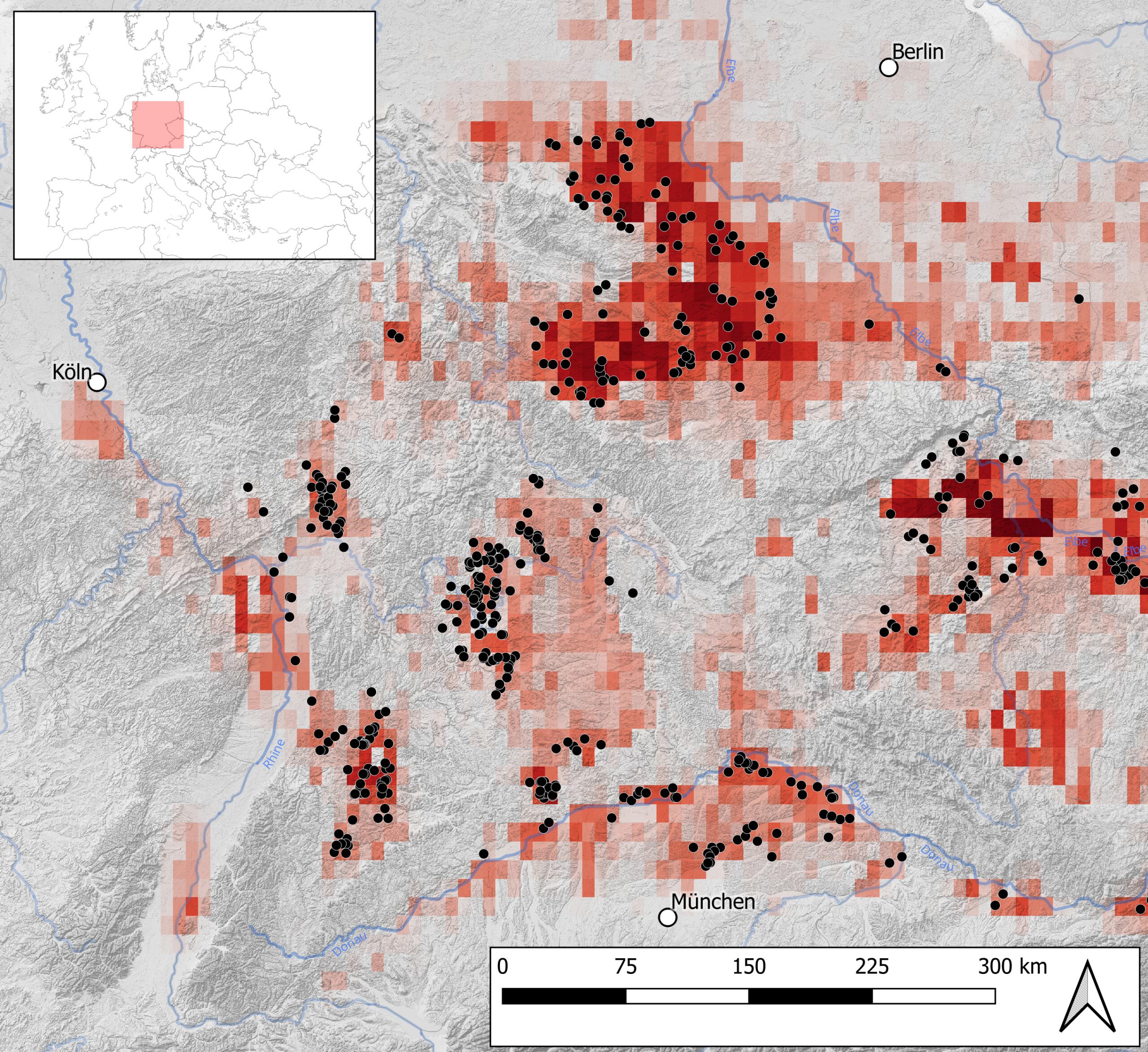
Figure: Example of sites and Human Existence Potential (HEP) calculations in the western distribution of the earliest Linearbandkeramik culture (LBK). Regions with higher potential (higher HEP values) are indicated in red tones, ranging from light to dark. Black dots mark sites of the earliest LBK occupation (after Fischer & Hilpert). The background map is the EMODnet World Base Map.
The spread of the LBK occurred in two main phases: first, groups of pioneers moved rapidly into new territories; later, larger communities followed and further expanded the settlement areas. Some regions were occupied quickly and permanently, while others were avoided or only settled sporadically, probably because the LBK way of life was less successful there.
The study shows that the first farmers were not simply reacting to their surroundings; they made deliberate choices about where to live and farm. They looked for fertile soils, access to water, and favourable climates. These decisions shaped how farming spread across Europe and how humans and their environments influenced each other.
By combining archaeology and environmental science, this research helps us understand how people learned to adapt to their world and how those choices continue to shape the landscapes we live in today.