In archaeology, classifying artefacts is a crucial but challenging task. Traditionally, experts identify and label artefacts by examining their shapes, materials, surface patterns, and other physical or topological features. This process relies heavily on human experience and subjective judgment, meaning that two specialists might classify the same object differently depending on their area of expertise or regional focus. Moreover, since artefacts come from a wide range of time periods and cultures, mastering every type is nearly impossible for one person. The manual process of measuring, comparing, and recording each item is therefore slow, labor-intensive, and prone to inconsistency.
Another major difficulty lies in building reliable image collections for automated analysis. Archaeological image datasets are often small and unevenly distributed—some object types have hundreds of examples, while others have only a few. Images also come in multiple forms, including field photographs, museum documentation, and hand-drawn illustrations, each with different lighting, style, and resolution. Such variability makes it hard for traditional computer programs to learn consistent patterns across images. As a result, creating large, balanced, and standardized datasets remains one of the key obstacles to digital artefact classification.
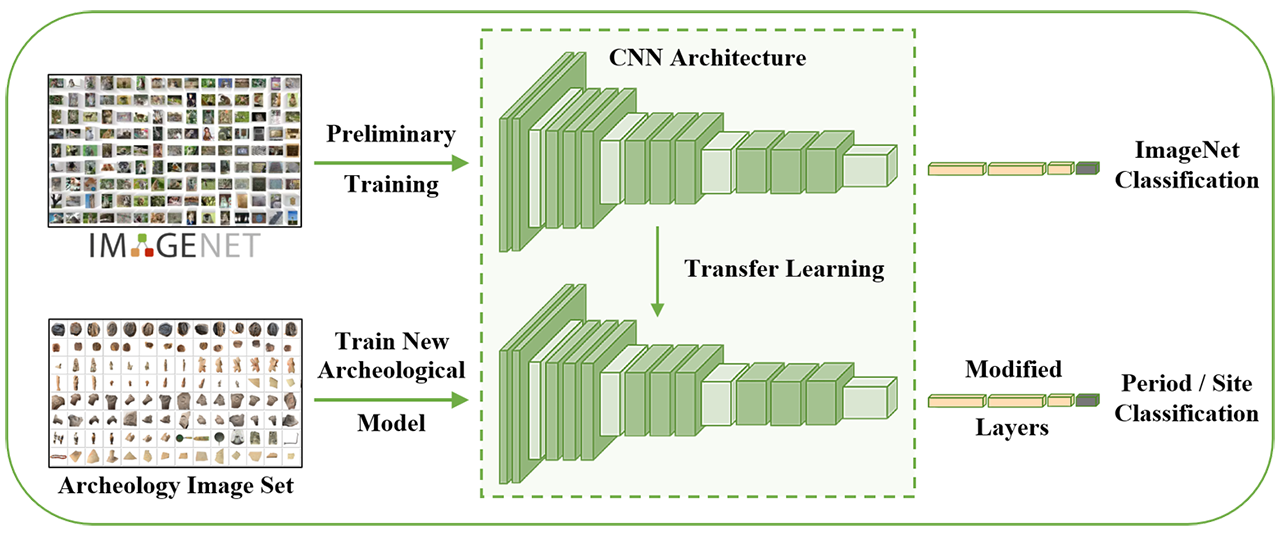
Modern transfer learning techniques based on convolutional neural networks (CNNs) offer an effective solution. As illustrated in the figure, these models first learn general image features from huge collections like ImageNet, which contain millions of everyday photos. The knowledge gained from this initial training can then be “transferred” to smaller archaeological datasets. By reusing the network’s learned visual understanding, researchers can extract meaningful features automatically, without needing to define them manually. This approach often outperforms human-crafted feature extraction, especially when data are limited.
Applying transfer learning to artefact classification has enormous potential. It can speed up identification in excavation records, improve consistency in museum catalogues, and help archaeologists trace cultural changes over time. By recognizing stylistic similarities or tool types across sites and periods, these AI-assisted systems could open new paths for studying the evolution and interaction of ancient cultures.
Please note that ChatGPT (OpenAI, https://chatgpt.com/) was used to refine parts of the text, which was subsequently edited by the author for structure, style, and content.