As a paleolimnologist (someone who studies past lakes), I mostly study sediments from cores. Cores are tubes of sediment that are often collected by drilling down into the bottom of lakes. These cores can be short (one meter) or long (hundreds of meters). The sediments closest to the surface are from today and deeper sediments are older. Once these cores have been collected, there are many different aspects of the core that we can study depending on our research questions.
During my PhD, I studied a core taken in 2004 from Lake Nakuru in Kenya. Lake Nakuru has the highest concentration of flamingos per area in the world, which is one of the reasons why it’s a national park! Flamingos are filter feeders and eat algae (like diatoms), small seeds, tiny crustaceans (like brine shrimp), and fly larvae from the water, meaning the lake is incredibly biologically productive. Lakes that sustain diverse ecosystems may have also been important resources for past hominins (our early human ancestors). Around Lake Nakuru there are archaeology sites all the way back into the Pleistocene about one million years ago!
In my most recent paper, I studied microscopic diatoms and the elemental composition of the sediments themselves (geochemistry) to understand how the lake might have changed before the African Humid Period. The African Humid Period is a time from 15 to 5 thousand years ago when northern and eastern Africa were much wetter, leading to a lot of movement and interaction between humans across the continent. Past studies have shown that during this time, Lake Nakuru was much deeper – especially considering it is only a couple of meters deep today!
From this study, the diatom and geochemical data together show phases of wet and dry periods from ~40,000 years ago until ~12,000 years ago, with the aridity curves (Dim1 and K/Ti) showing drier phases to the right and wetter phases to the left. We were also able to learn from our proxies about how biologically productive the lake was as well as whether there were times when the lake had less oxygen in it (anoxic). While we don’t yet know what may have caused these different phases, we propose that it could be related to changing temperatures of the ocean all the way near Greenland! Just another example of how complex and intertwined the Earth System is!
Link to the paper: https://doi.org/10.1016/j.quascirev.2025.109579
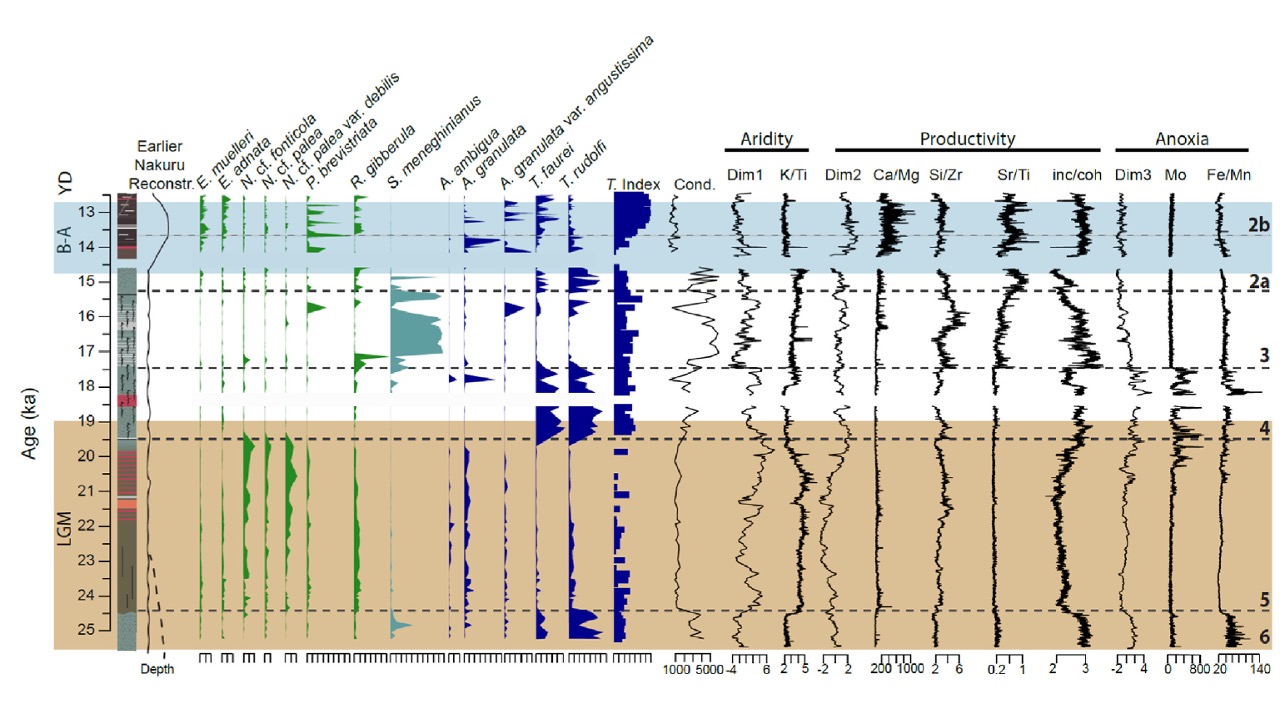
Fig.: Different measurements from Lake Nakuru through time. This includes diatoms that represent at least 10% in one sample ; T. Index which shows potential depth; conductivity (amount of salts in the lake); aridity (Dim1 and K/Ti); biological productivity (Dim2, Ca/Mg, Si/Zr, Sr/Ti, and inc/coh); and anoxia (Dim3, Mo, and Fe/Mn). Global climate phases are highlighted with the anticipated dry phase (Last Glacial Maximum, LGM) in brown and the anticipated wet phase in blue (Bølling–Allerød interstadial, B-A).