How people moved and interacted across past landscapes is a key question in archaeological research. Within HESCOR, teams from the Departments of Prehistoric Archaeology and Mathematics at the University of Cologne are working together to better understand these processes. Their collaboration connects archaeological evidence with modelling approaches to study mobility as a central factor in human–environment dynamics.
The project focuses on two well-documented phases of European prehistory: the Magdalenian (around 20,000–14,000 years ago) and the Linearbandkeramik (LBK) culture (around 5400–4900 BCE). Both periods are associated with significant movements of people and the formation of far-reaching networks of interaction. However, the precise nature of these movements remains an open question.
Archaeological data like the distribution of raw materials form the foundation of this study. Especially data on stones used for tool production provides important clues about connections between different regions. These data help reconstruct networks of contact, exchange, and communication that existed between prehistoric groups.
To analyse these connections, the research team develops network models that translate archaeological information into visual and analytical forms. These networks highlight potential connections between groups, such as clusters of sites or long-distance links, that can be related to mobility and migration. Rather than assuming one model of migration, this approach allows researchers to explore any potential possible pathways and relationships. In order to obtain an even better picture of movements, information on “effective distances” will later be included in the formation of the networks. These describe not only how far places are from each other as the crow flies, but also how people were actually able to move between them based on the topography (see).
These archaeological networks form the empirical basis for future modelling steps. The long-term goal is to integrate network structures with ecological and environmental data in order to understand how social and environmental factors shaped human movement. The idea of future modelling approaches has been discussed in a previous blog-post.
By combining archaeological case studies with quantitative analysis, this work contributes to HESCOR’s broader aim of coupling Human and Earth systems. It offers a framework for examining how mobility influenced cultural development, adaptation, and the formation of regional groups in prehistoric Europe.
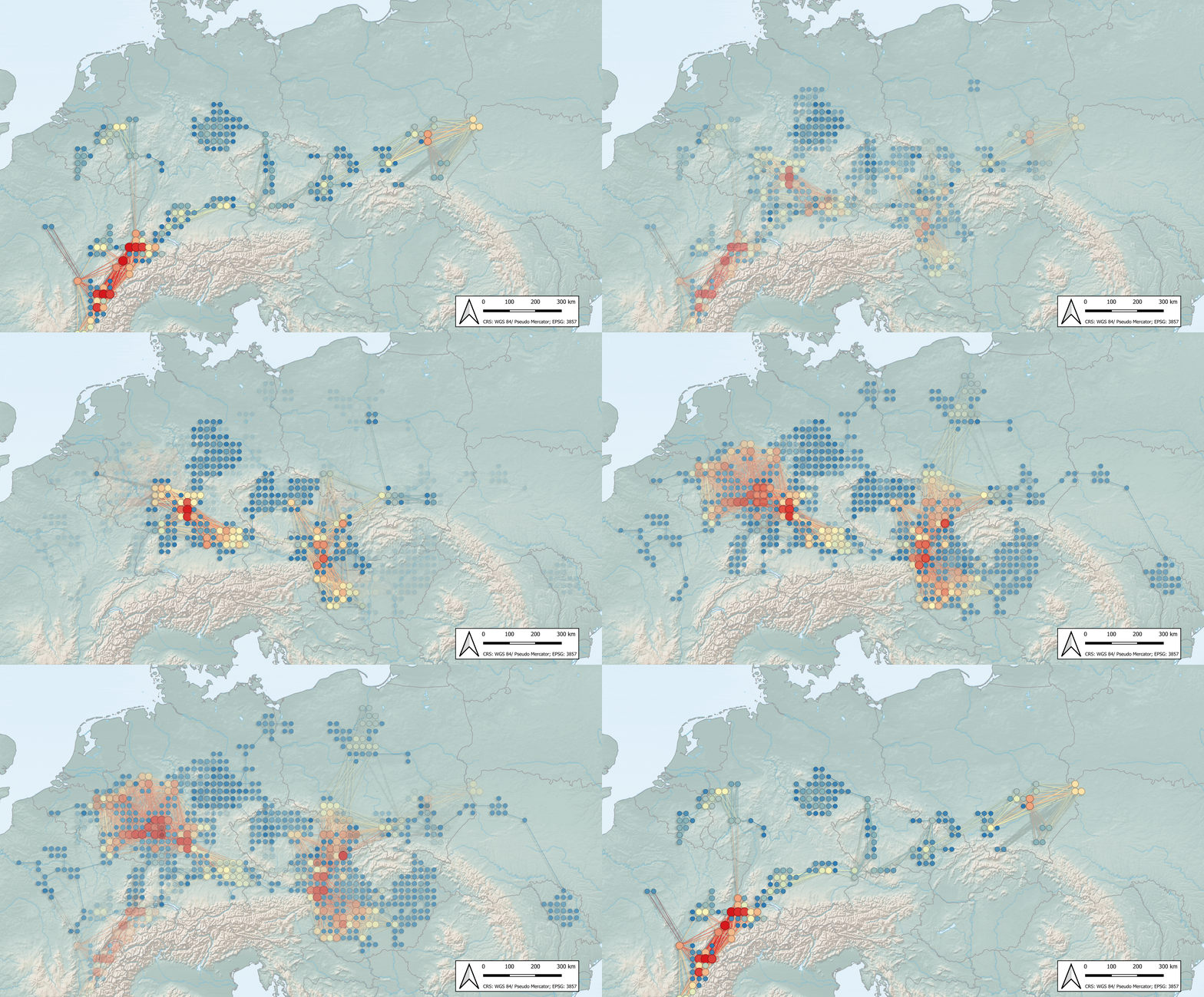
Examples of contact networks for a) the Magdalenian period, b) the earliest LBK, and c) younger LBK phases. The size of each circle (node) shows its degree — how many connections it has to other places. A higher degree means more links and more contact; a lower degree means fewer connections.